
The Sam Mills Effect
The expansion Carolina Panthers knew exactly what they were getting when they signed the 35-year-old Mills. He led them to the NFC Championship Game in the team's second season.

In 1995, after nine prolific seasons with the New Orleans Saints, 35-year-old Sam Mills signed with the expansion Carolina Panthers. He played just three seasons for the Panthers, but had such an impact on the franchise that they built a statue of him outside their stadium and is the only player in franchise history to have had his number retired. This excerpt from my new book on Mills, “Just Give Me A Chance To Fail,” deals with his move to the Panthers:
From the minute Vic Fangio arrived in Charlotte to become the Panthers’ defensive coordinator, he had lobbied hard to sign Sam Mills. They had been together for 11 years—nine in New Orleans and two in Philadelphia. They were good friends. Fangio knew the Saints were in a salary-cap bind and hadn’t yet made an offer to Mills, who was about to become a free agent. He also knew better than anybody that, despite his advanced age, Sam still had plenty of gas left in his tank. “To get a guy of Sam’s stature and his ability and what he would bring to a new franchise, to me it was just a no-brainer,” he says.
Panthers head coach Dom Capers, like Fangio, was all for bringing in Mills. He told general manager Bill Polian he couldn’t think of a better guy to start a new franchise with.
Polian, who as a young scout with the Chiefs in 1981 had made the mistake of thinking Mills was too short to play in the NFL, long ago realized he had gotten that wrong. As soon as Capers brought up Sam’s name, he contacted Brett Senior and offered Mills a two-year, $2.8 million deal, which was pretty good money at the time. Senior reached out to his client, who happened to be at Disney World at the time with his family. Sam wasn’t going to make the decision on his own. Everybody had a say. He and Mel and the kids held an impromptu meeting in their hotel room and voted unanimously to take the Panthers’ offer.
“He asked us what we thought,” said Marcus, who was 12 at the time. “His feelings about the way the Saints had treated him were pretty clear. We were all onboard for going to Charlotte. All I had ever known was New Orleans. I was excited to see what else was out there. I think my dad was too.”
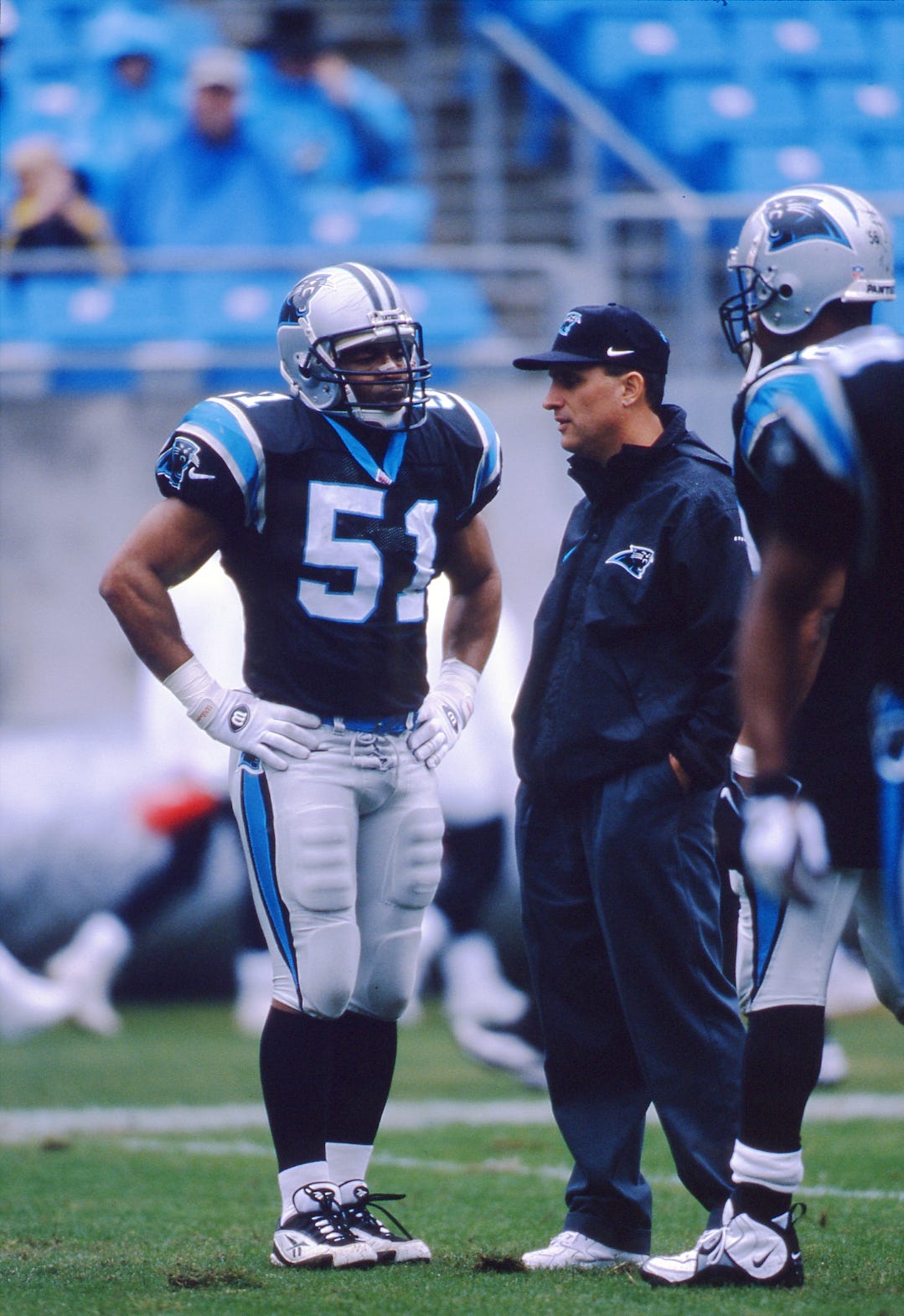
With the possible exception of Capers and Fangio, nobody was more excited to have Mills sign with the Panthers than Brett Maxie. Maxie and Mills had been teammates in New Orleans for eight seasons. They were also close friends.
Maxie, a safety who started 72 games for the Saints, had left New Orleans a year before Mills after suffering the second ACL tear of his career. He considered retirement, then signed with the Falcons in ’94 before joining his old Saints position coach, Capers, in Carolina after he got the head-coaching job. Maxie signed with the Panthers a couple of weeks before Polian made the offer to Mills.
He was in Capers’ office at the team’s training facility at Winthrop University in Rock Hill, South Carolina, about 25 miles south of Charlotte, watching game film when the Panthers head coach told him they were going to try to sign Mills.
“We’re going to make him an offer,” Capers said. “I think he wants to come. But why don’t you give him a call? It would help.”
Maxie called Sam. He told Maxie he was excited about the prospect of playing for a new team.
“We’re going to make it happen, Max,” Mills told him. “I never thought I would ever be leaving New Orleans. But I think I have to.”’
For the second time in his career, Sam Mills was joining a startup franchise. He helped lead the first one, the Philadelphia Stars, to two USFL championships in three years. Now, at the age of 35, after four Pro Bowl appearances with the Saints, he was getting in on the ground floor of an NFL expansion team.
His signing with Carolina in early March of 1995 barely caused a ripple in the NFL free agency waters, even in Charlotte. The Dallas Cowboys’ signing of Deion Sanders to a seven-year, $25 million deal got the biggest national headlines. Sanders had been the NFL’s Defensive Player of the Year with San Francisco the season before. A week before signing Mills, the Panthers flexed their salary cap muscles by handing out a five-year, $13.8 million deal to 28-year-old pass-rushing linebacker Lamar Lathon.
Mills’ signing flew well under the radar. Counting his three years in the USFL, he had played in nearly 250 professional football games. Besides Carolina and the Saints, no other teams had expressed any serious interest in signing him.
But the Panthers knew what they were getting. Mills would provide immediate leadership to a young expansion team. He would be a steadying force and a coach on the field.
“I had so much trust in him that I was going to listen to everything he said,” Capers says. “It didn’t take long for our players to feel the same way.”
Much like he did in New Orleans, Mills mentored younger teammates and helped many of them deal with the pressures of professional football.
Lathon, who would record 21 ½ sacks in his first two seasons with Carolina, was an extraordinarily talented athlete. At 6’3” and 260 pounds, he was a physical freak and had incredible power, explosion, and range. But he also was high-strung and had a short fuse. Mills kept him focused and under control.
“The second Sam would see Lamar losing his cool and losing his concentration, he would settle him down,” Capers says.
The Panthers won the coin flip with the league’s other expansion team in ’95, the Jacksonville Jaguars, so they had the first pick in the draft. Everyone thought they were going to take Penn State running back Ki-Jana Carter.
But Polian wanted a quarterback to build his new team around, much like he had done in Buffalo with Jim Kelly. He traded out of the top spot down to No. 5 and took Carter’s Penn State teammate, Kerry Collins.
The 6’5”, 247-pound Collins had a linebacker build like Kelly. He was a sturdy, strong-armed quarterback who would go on to play 17 years in the NFL and start 180 games. But the early part of that long career was, for lack of a better word, erratic.
When he arrived in Charlotte in ’95, Collins was very immature and more interested in enjoying the celebrity perks of being a professional athlete rather than putting in the time to learn how to become a consistently productive NFL quarterback. “He went into the NFL thinking it was going to be one big party,” his brother Pat said later.
Collins lasted just three seasons and a part of a fourth with the Panthers before they ran out of patience with his drinking, partying, immaturity, and inconsistent play, and released him. He would eventually get sober and turn his career around, but not in Carolina.
Mills tried unsuccessfully to get through to Collins. One time, Collins admitted to reporters that he was dealing with a lack of confidence. Mills sat him down and tried to talk him through it and give him some advice on how to deal with the media.
Another time, during training camp in Spartanburg, South Carolina, a drunk Collins was at a nightclub with some of his teammates and made a racist joke. He was an immature kid and was just trying to be funny and fit in. He thought his Black teammates would laugh. They didn’t. The story got out and Collins found himself branded as a racist. He made a public apology, but the damage had been done.
“Sam sat me down and said, ‘C’mon, man. You’re better than this,”’ Collins says. “It wasn’t judgmental. He was trying to help me. I always appreciated that. Unfortunately, at the time, I was battling a lot of stuff and wasn’t ready to be helped at that point. But I was always grateful to Sam that he took the time to try and help me.’’
Mills’ leadership skills were off the charts. Hall of Fame coach Tony Dungy has a phrase he likes to use: quiet strength. It fit Mills to a tee. Sam wasn’t a yeller or screamer. If he had something to say, it came from his soul. And the value of those words was multiplied by 100.
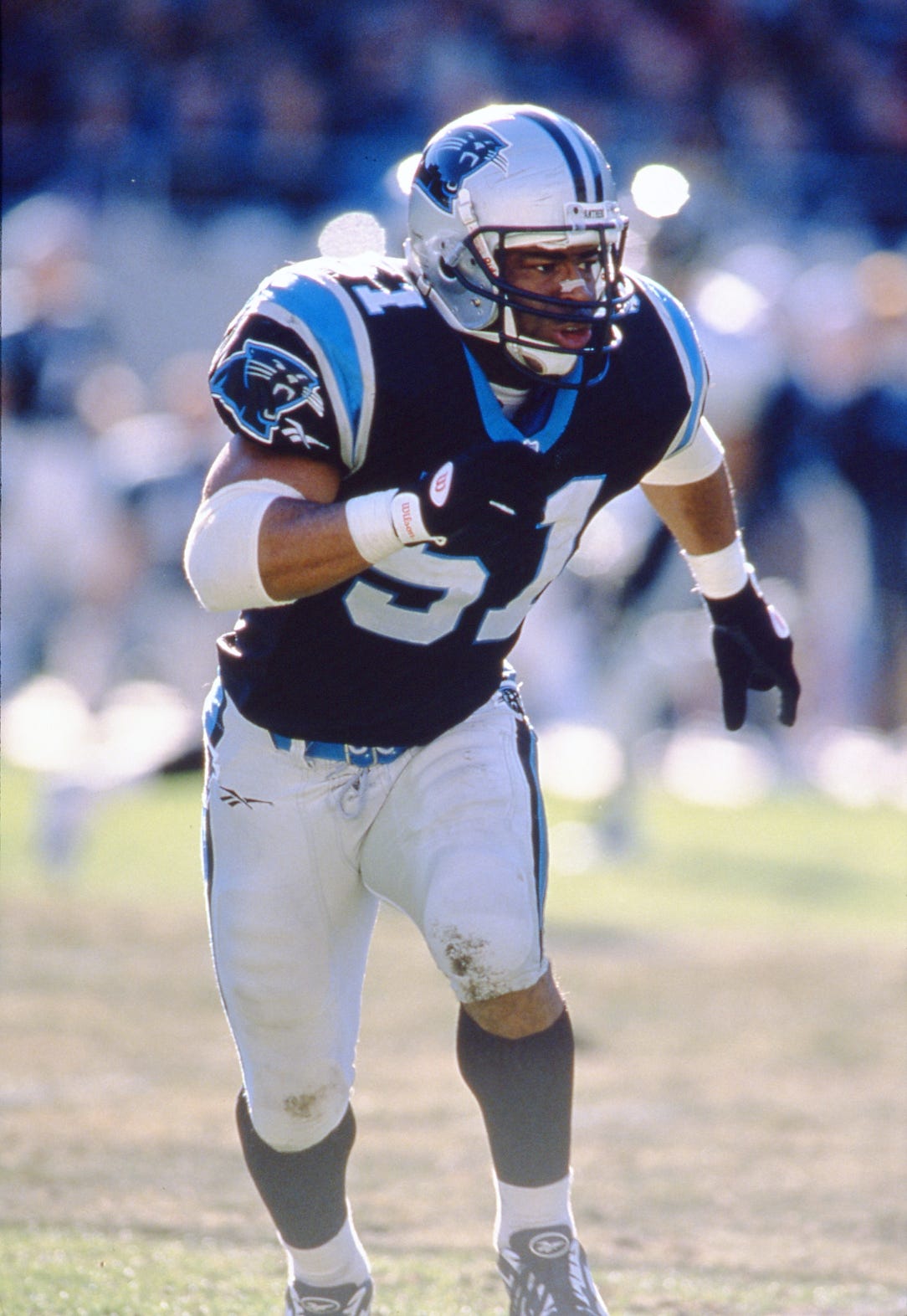
“Sam was a thermostat instead of a thermometer,” Brett Maxie says. “You could see the room change when he walked into it. He was just the consummate pro and teammate because he was always doing the right thing, even when nobody saw it.
“It was how he challenged men to get better. A lot of great players would meet Sam for the first time and immediately feel like they had known him their whole lives because the impact he made on them was genuine.”
The veteran Mills was the perfect fit for the inexperienced Panthers in so many ways in ’95. Capers was a first-time head coach. Fangio was a first-time defensive coordinator. Kevin Steele, the team’s inside linebackers coach, came from the college ranks and had never worked in the NFL before. Bill Davis, who was the team’s outside linebackers coach, had been a defensive assistant under Capers in Pittsburgh but had never been in charge of a position group before.
Mondays and Tuesdays typically are off-days for players in pro football. But never for Mills. He called them his “advantage days.” Those were the days when he got to be the coach and do the work. He would get an early look at the defensive game plan from Fangio. He would have Sam III or Marcus quiz him on it. By Wednesday, when the coaching staff would be giving the rest of the team the game plan for that week, Mills already had committed it to memory and would help his teammates learn it.
“The biggest piece for a defensive player is [figuring out] if it’s going to be run or pass,” Bill Davis says. “You have a run assignment to execute and a pass assignment. That’s hard. But when Sam gives you the answer to the test before the play, well, now your chances for success go through the roof. That’s what Sam brought to a young team. It was a hidden value that he brought to every practice and every game.”
Kevin Steele had spent 14 years as a college assistant at Tennessee, New Mexico State, Oklahoma State, and Nebraska before Capers hired him. The Panthers were his first NFL job. Steele was a very good coach, but there’s a significant learning curve when you go from college to the NFL, whether you’re a player or a coach. Mills helped Steele navigate that learning curve.
“Many of the coaches on that staff had an impact on me as I made the transition,” Steele says. “But to be quite frank with you, Sam taught me more about being a pro coach than anybody else, and it wasn’t even close.”
Like Fangio, Steele was only a year older than Mills. He would ask him questions about the pro game and would even ask him questions about Fangio and Capers’ defense since Sam knew it a lot better than he did.
“I tell people all the time, as a rookie coach in the NFL, coaching a guy that was pretty close to the same age as me, the transition was pretty easy because Sam didn’t allow me to make mistakes,” says Steele. “He was always there to make sure, in his coded way, to not let me make mistakes as a transitional coach.”