

Staying Power
Merrill Reese, who once was told by a radio executive that he had no future in broadcasting, is getting ready to celebrate his 50th year as the play-by-play voice of the Philadelphia Eagles.

Merrill Reese was sitting in the media tent at the Philadelphia Eagles’ training camp last summer when someone came out of the team’s locker room and handed the team’s long-time radio voice a box.
Inside the box was a pair of brand-new custom Air Jordan Eagles cleats. On the white toe of the cleats was an inscription: To M. Reese. You saw it when nobody else could. Love always, Jalen Hurts.
You may recall that the Eagles received quite a bit of criticism from both fans and media in 2020 when they selected Hurts in the second round of the draft, just 10 months after giving Carson Wentz a $128.9 million contract extension.
But Reese, who is entering his 50th year as the “voice’’ of the Eagles, applauded the move from moment it was announced and has been one of the quarterback’s biggest advocates during his six seasons with the Eagles.
“That meant more to me than the [Super Bowl] rings,’’ Reese said of the Air Jordans. “I mean, rings are great and they mean a lot to me. I don’t mean to minimize that.
“But to think that the quarterback, the Super Bowl MVP, would think about something other than himself and appreciate the fact that I’ve been somebody who has believed in him from the beginning, well, that meant a lot to me.’’
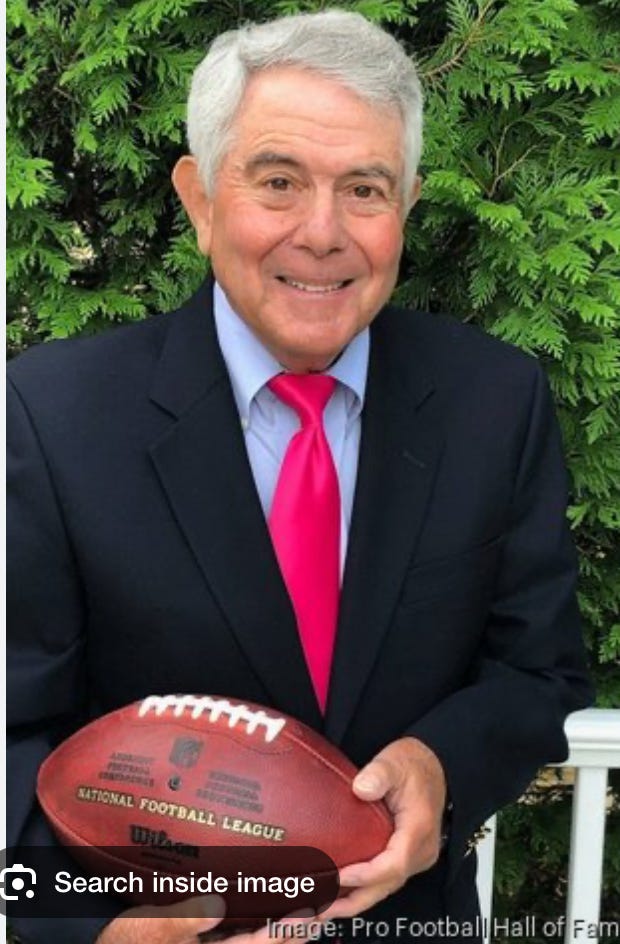
Life has been very good to Merrill Reese. He’s been married to Cindy, the love of his life, for 47 years, or as they say, 23 ½ if you don’t count football season. They have two children – Nolan and Ida – and two grandchildren.
He is less than two months away from his 84th birthday and still is healthy and fit enough to play golf 4-5 times a week during the summer before training camp starts.
Reese is the longest tenured radio play-by-play broadcaster in NFL history. Fifty years and counting. Fifty years!
In April, aware of Reese’s approaching milestone, Hurts approached the team and asked if he could do a little bit of role reversal and interview the broadcaster.
“We went up to the draft room,’’ Reese said. “What it really was was an hour of conversation. It wasn’t really a Q&A. It was him talking to me and me talking to him. Just back and forth.
“It was one of the most enjoyable hours of my life sitting there with him and talking football and our attitudes and thoughts going into games and what he feels. It was really amazing because he’s a quiet guy. He’s not Mr. Outgoing Broadcast Personality. He’s one of the most sincere, nicest people on the face of the earth.’’
The quarterback’s interview with Reese will air on all of the team’s online channels on September 8. A week later, on the 15th, WIP, which airs Eagles games, will celebrate Reese’s 50 years in the booth with a special event at the Kimmel Theater.
For his part, Reese is taking all of the hoopla in stride. While he certainly understands the significance of his historic run, 50 is just another number for him.
“I just love doing this so much,’’ he said. “I’m as excited as ever for the season to come. I truly appreciate [the attention], but it’s just not my focus. My focus is football and doing the best job I can.’’
It’s not unusual for broadcasters, like athletes, to “lose a step’’ as they get older. But Reese still is at the top of the game. His distinctive baritone voice is still as strong and as appealing as ever. His ability to paint a picture of the game for the listener is as good as ever.
“My eyes, my voice and my memory are the same, thank God,’’ he said. “That’s why I can still do it and still love to do it. Physically, I feel great.
“The thing that people worry about in this job is your eyes. But I had cataract surgery a number of years ago and my eyes are great. I have some distance glasses that I’ll put on from time to time if I’m in a tough stadium.
“But my voice, I listen to tapes, and it hasn’t changed. I don’t smoke or do anything to hurt my voice. I don’t yell. The night before a game, I’m very careful with my voice. I don’t talk much on the phone the day before a game. I try to kind of go into training a little bit the day before a game.’’
Reese has been working with the same people for years. His partner on Eagles broadcasts, former All Pro wide receiver Mike Quick, is entering his 28th year in the Eagles booth. Producer Joe McPeak has been with Reese for 41 years. His spotter, legendary talk-show host Bill Werndl, has been with him for 35 years.
“Merrill has a lot of history and has tremendous recall of that history,’’ said Quick. “He has a lot of things that make him the great – and I do say great – broadcaster that he is. But the most important thing is the passion that he brings to it every time. It’s a passion that seems like it’s the first time every time.’’
Over the years, Reese has had offers from the television networks that broadcast NFL football to come work for them. It would’ve meant more money, more national prestige and recognition. But he said he never has been really tempted to leave.
“I love the lifestyle I have in that I only travel half the time [compared to being on the road every week as a network broadcaster],’’ he said. “I’ve been able to be home with my family.
“And I love doing Eagles games. It’s the team I grew up rooting for. And I love doing radio and painting the picture [for listeners] rather than filling in the essentials [on television broadcasts]. It’s just what I love doing.’’
Reese, who was inducted into the Eagles Hall of Fame in 2016, is one of the best football picture painters who has ever lived. Two years ago, he was presented with the Pete Rozelle Radio-Television Award by the Pro Football Hall of Fame. Previous winners included Joe Buck, John Facenda, Al Michaels, Andrea Kremer, John Madden, Jim Nantz and Brent Musberger.
He was driving on the Blue Route on his way to play golf two years ago when Jim Porter, the president of the Pro Football Hall of Fame, called him to let him know he had won the Rozelle award.
“I pulled over and all I could do was cry,’’ Reese said. “I’m not Dick Vermeil, who cries at basketball games. But I was really emotional. When I called Cindy to tell her, I started crying again. She got concerned. She said, “Have you been in an accident? Are you hurt?’ I said no, no, no. I’m going into the Hall of Fame.’’
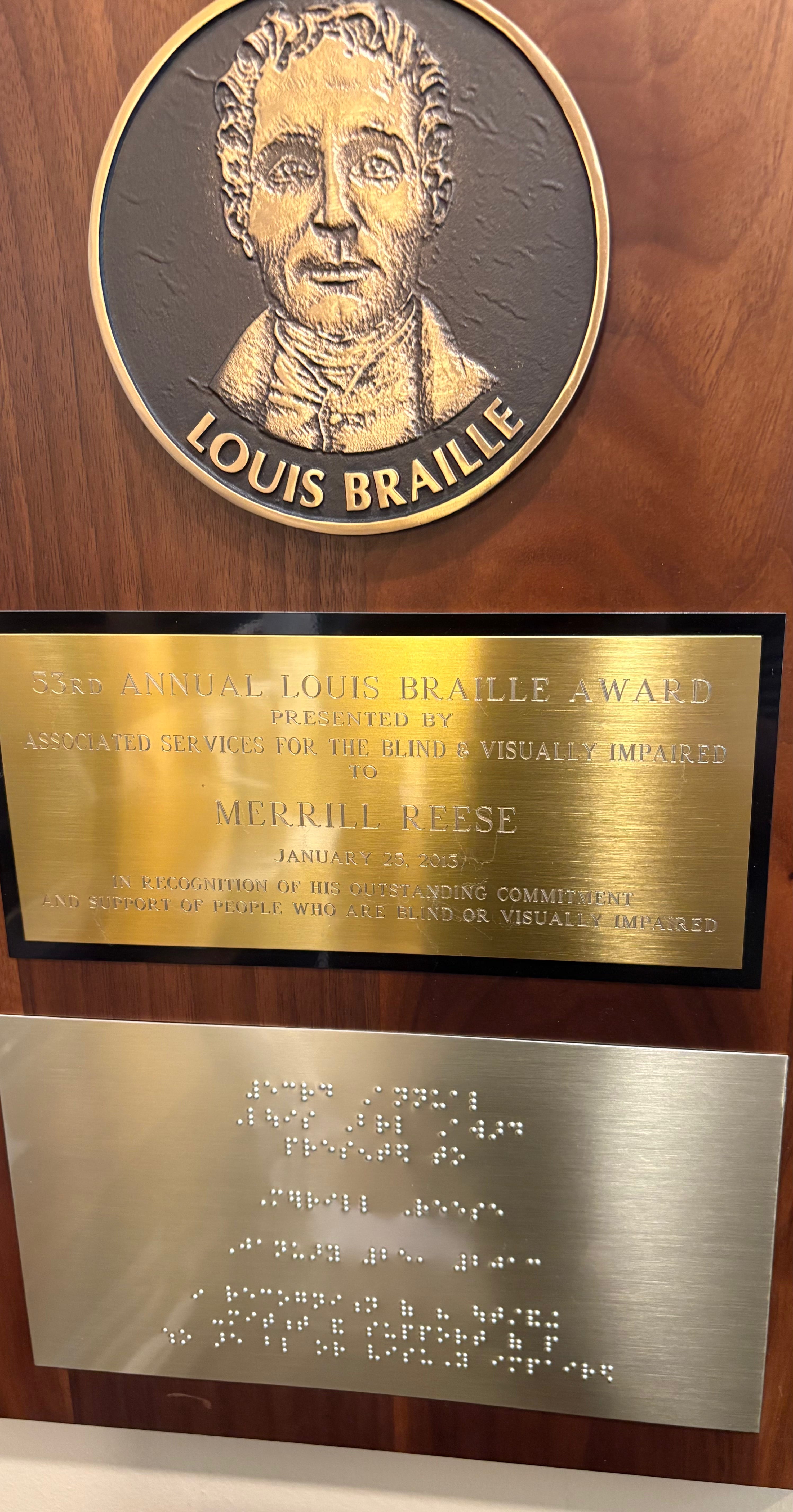
An honor that means every bit as much to Reese as the Rozelle award and his induction into the Eagles Hall of Fame, was one he received in 2013 from the Allied Services for the Blind, the Louis Braille Award. The plaque hangs in a prominent spot in his office.
“I’ve received countless emails and letters over the years from people who are unsighted who thank me for teaching them football and allowing them to enjoy the game through my eyes,’’ Reese said.
Reese said a radio play-by-play man has to be fundamentally sound. He calls it STDD – score, time and down-and-distance.
“If I don’t give the score every minute-and-a-half or two, Joe McPeak puts a card in my face that says score/time,’’ he said. “You’ve got to be fundamentally sound. Don’t get so hysterical on a play where [the listener] can’t follow it.
“No one knows this, but I’ll slow it down a little bit. I may be a second behind the catch or the move because it’s easier for people to follow. I’m broadcasting to people who can’t see the game, so I have to paint the picture for them. And you can’t do that if you’re talking a million miles a minute.
“They can’t understand you. I’d rather say [slowly], ‘complete to DeVonta Smith in the corner of the end zone,’ rather than [faster and more excited], ‘completoDeVontaSmithinthecorneroftheendzone!’’’
Reese’s early career aspiration was the same as a lot of young boys. He wanted to be a professional athlete. “I was like every other kid, dreaming of striking out the last batter in the ninth inning of the World Series or making the one-on-one [free throws] that won the basketball game,’’ he said.
Reese grew up in the Overbrook Park section of Philly. His father was a dentist and his mother was a kindergarten teacher. They lived in the house behind his father’s dental office.
His mother had show-business flair. She was a dancer and ran her own dance school during summers when she was in college.
When Merrill and his sister were young, their mom would take them for drama and singing lessons. By the time he was nine, Reese was appearing in television commercials. He also made regular appearances on a local radio show called Let’s Pretend.
His drama teacher insisted that he memorize the script for the show rather than read it. So, his mother would help him memorize a 26-page script until he knew it backwards and forwards.
“I attribute that to the fact that I can memorize a roster very quickly,’’ Reese said. “Cindy walks around the house with flashcards during the week. She picks one up and calls out a number. When people say I have an amazing memory, I really believe it developed at a very early age when I was memorizing those scripts.’’
Reese’s first broadcasting job was doing high school games for WPAZ in Pottstown. The station owner had some initial reservations about hiring Merrill. “He looked at me and said, ‘I’d give you a chance, but you look like you’d have a nervous breakdown [on air],’’’ he said. “I had no confidence at that point.’’
The station owner decided to take a chance on Reese, mainly because he didn’t have any other options. He told Merrill that it was between him or dead air.
His first play-by-play assignment was a high school football game between Pottsgrove and Spring-Ford. He didn’t have a nervous breakdown, handled the assignment well and was hired full-time, working seven days a week for the princely sum of $65.
He went to WBCB in Levittown from there. While he was working for them, he auditioned for a job at KYW Radio. The news director at KYW at the time was a guy named Reggie Laite. He had Reese write and record a newscast.
“When I was done, I thought I had absolutely nailed it,’’ Reese said. “I didn’t mispronounce any words. I didn’t stumble. He called me and said, ‘I’m going to do you a big favor.’ I’m thinking, ‘Oh, man. I’m going to be on 50,000-watt KYW.’
“Then he said to me, ‘This is the nicest thing anybody will ever do for you. I’m going to tell you that if you want to have a productive career, if you want to make a successful living, it’s got to be in another field.’
“He said, ‘You will never work in a major market because you don’t sound like what we want people to sound like. You sound different. Go into something else.’’’
Needless to say, Reese was absolutely crushed. Here was a respected news director at one of the biggest radio stations in the country telling him he had no future as a broadcaster.
He was still living at home at the time. When he got home that night, his mother could tell something was bothering him.
“What’s wrong?’’ she asked him.
He told her what Laite had said.
“You know what, he’s right,’’ his mother said.
A stunned Reese looked at his mother and said, “What do you mean he’s right?’’
“It’s my fault,’’ his mother said. “Because I obviously raised a weakling. If you’re going to let one guy throw you so off-kilter that you can’t even look at your dinner, then he’s right.’’
His mother’s message got through to Reese loud and clear. The next day, he went back to WBCB, determined to prove to Reggie Laite that he was wrong about him.
From WBCB, Reese went to WWDB, which was a jazz music station with hourly newscasts at the time. At one point, he went to the program director and suggested doing five minutes of sports on the hour from 6 to 9 in the morning. The program director told him it wasn’t a sports station.
“How about if I come in and do the sports at 6:05, 7:05, 8:05 and 9:05 for free, then come back and do my regular news shift from 12 to 8?’’ Reese said.
“Hmmm,’’ said the program director. “Maybe sports in the morning could work.’’
A couple of years later, Reese found out that WIP was looking for somebody to fill in for the station’s sports director, Charlie Swift, during his month-long summer vacation. Swift also was the Eagles’ play-by-play man for their broadcasts on WIP.
Merrill auditioned and got the job. He did so well that they offered him a job doing the pre- and post-game Eagles shows and the coach’s show. He did that for four years until 1977, when he replaced Al Pollard, a former Eagles running back, as the color analyst on Eagles broadcasts alongside Swift.
“It was different for a non-player to do color,’’ Reese said. “But I came prepared. I was always armed with a lot of information. I’d be at practice every day. I prepared.’’
The ’77 season was Dick Vermeil’s second as the team’s head coach. He still was in the throes of rebuilding. His first Eagles team had finished 4-10.
A 24-14 early-December road loss to the Dallas Cowboys dropped the Eagles to 3-9 in ’77. As they were getting off the team flight in Philly that night, Swift turned to Reese and said, “I’ll see you next week, kid.’’
Three days later, Swift put a gun to his head and killed himself.
Reese replaced Swift as the interim play-by-play man for the Eagles’ final two games that season. Future Hall of Famer Herb Adderley stepped in as the color analyst.
“I had sat next to Charlie for 12 games and paid attention to everything he did,’’ Reese said. “I knew how mechanically sound he was. I also had done all of the Temple games in college for the student station. And one of the years I was at WWDB, I got them to pick up Penn football and did that. So I knew how to do play-by-play to a point.’’
Reese did a good job broadcasting the Eagles’ final two games that season, but wasn’t immediately offered the job on a permanent basis. Al Meltzer, who had been the sports anchor at Channel 3 from 1970 to 1977 before moving to Chicago, wasn’t happy in the Windy City and wanted to come back to Philly.
Channel 10 wanted to hire him as their sports anchor and he also was WIP’s No. 1 choice ahead of Reese to replace Swift as the Eagles’ play-by-play man.
“What’s easier to sell to sponsors?’’ Reese said. “The name of Al Meltzer, who everyone knew? Or me, who basically was a pre- and post-game guy? I wasn’t going to translate into instant [advertising] dollars.
“I had this dream all winter where they called me and told me I had the job, and then I’d wake up and realize it was only a dream, The other dream I had was them telling me they decided to go in another direction, and I’d wake up happy.’’
WIP eventually offered the job to Meltzer, but he also wanted the Channel 10 job. WIP told him it had to be one or the other. He opted for Channel 10, clearing the way for Reese to become the station’s sports director and the voice of the Eagles.
As he was driving to the radio station to sign his new contract, he suddenly wondered if being offered the Eagles job had been another dream.
It wasn’t.
Fifty years later, Reese still prepares for a game the same way he did back then. Stan Walters, the former Eagles offensive tackle who was Reese’s broadcast partner from 1984 to 1997, used to say his pal would go into Merrill mode before a game, poring over his information and studying it.
“He gets locked in,’’ Mike Quick said. “He has his routine, and he doesn’t like to break routine. From the time he wakes up in the morning [on game day], the routine starts then. And it really works.
“The sweet thing for me is, I know I’m working with a living legend when I walk in there. I know that I’m in a really good place.’’
So does the listener.
At some point, Reese will ride off into the sunset. But not anytime soon. He still loves what he’s doing. He still is at the top of his game.
“I’ll never want to stop,’’ he said. “There obviously are things that realistically could factor in at some point. Vin Scully did it until he was 90.
“But I still get the same thrill out of it. I still love it as much as ever. I actually see a game better now than when I first started. Quarterbacks talk about how, after a while, the whole game slows down for them. The same thing with me.’’
Cindy has written a book about her husband’s prolific career. It’s titled His Story: Merrill’s 50 Years With the Eagles. Published by Temple Press, it will be released next February around the Super Bowl.
This was great, Paul. Merrill has been around for as long as I've been following the Eagles (I started in 1978 as an 8-year old). He still sounds great, and I'm glad to hear that he is still in good health at his age. I'm looking forward to seeing that interview of him by Jalen Hurts.
Paul this was amazing. Not surprised because you've always been elite. I grew up reading you so I am blessed that we follow each other here. I'll be 53 this year and Merrill is definitely the soundtrack of my life and even more since I don't live in the Philly area now and listen to him when the Eagles aren't the main game in my area. I refuse to buy Sunday Ticket. I'll watch Red Zone and listen to Merrill whenever the Eagles aren't the main game in my area.