
'Keep Pounding'
In this final excerpt from my new book, "Just Give Me A Chance To Fail,'' I look back at Sam Mills' inspirational speech to the Carolina Panthers before the 2003 playoffs.

“It was an emotional speech and it stuck. He was going through chemo. He was dying. He understood the reality of his situation. He just told the guys, ‘Hey, look. No matter what the situation is, you’ve got to keep looking forward. You’ve got to keep fighting. You’ve got to keep on pounding.’”
—Jim Skipper
No one, and I mean no one, had NFC-champion Carolina Panthers on their bingo card heading into the ’03 season. Google the preseason Las Vegas odds for that year and you’ll find that just four other NFL teams were given a slimmer chance of making it to the Super Bowl than the Panthers.
The Panthers were just two years removed from 1–15. They had improved their win total by six games in ’02, which clearly was a promising sign. But heading into the ’03 season, they didn’t even know who their starting quarterback was going to be, and neither of the options—37-year-old journeyman Rodney Peete and inexperienced Jake Delhomme, who had spent the previous four years as the Saints’ third-string quarterback—seemed all that enticing.
Sam and Mark Fields’ cancer diagnoses were also weighing heavily on everyone’s minds entering the season, both inside and outside the locker room.
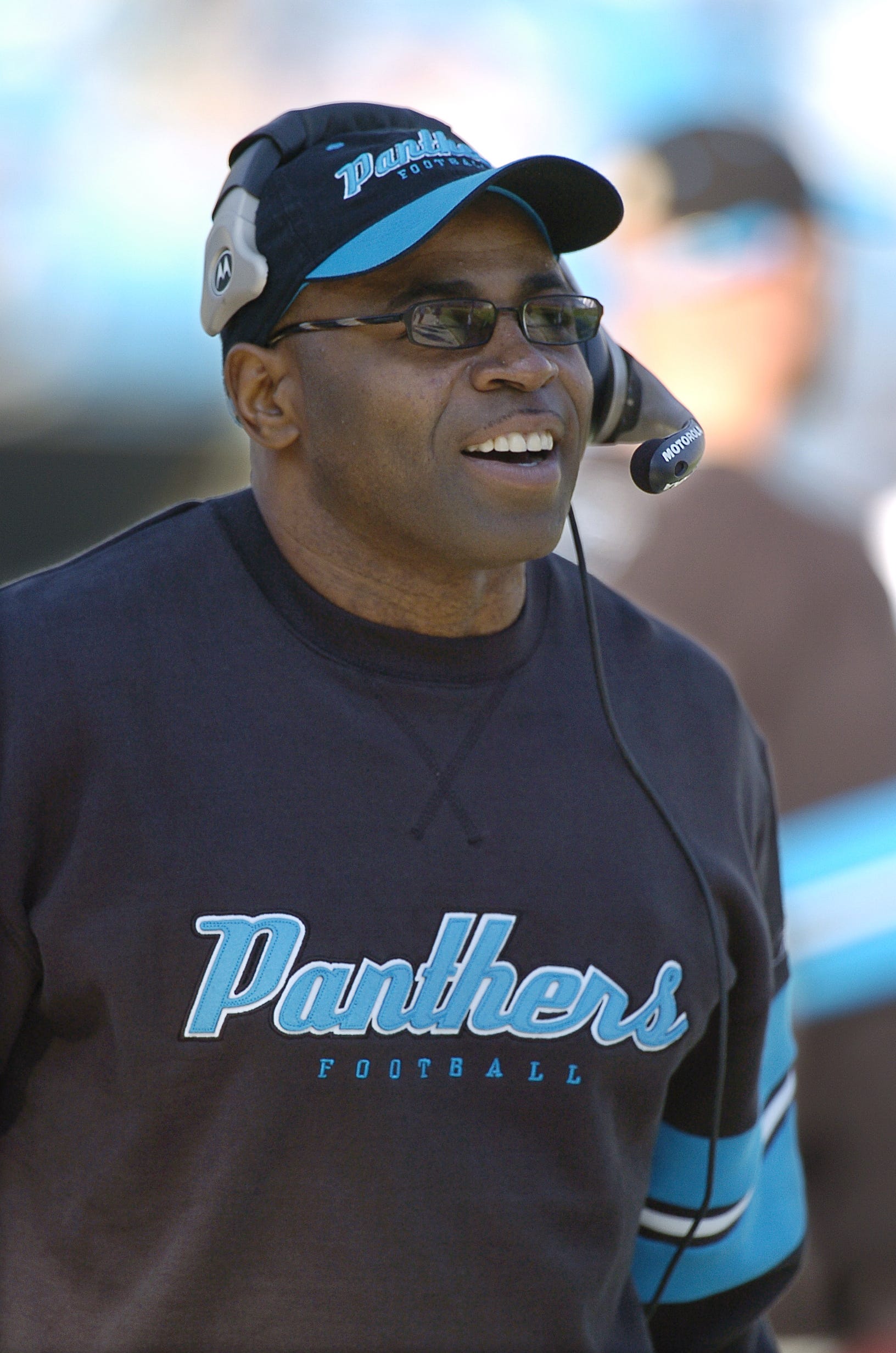
Fox settled on Delhomme as his starting quarterback. Delhomme was competent, throwing three more touchdown passes (19) than interceptions (16). But the Panthers’ ’03 offense under Dan Henning was more the old-school ground-and-pound than quarterback-driven.
They had signed former Washington Redskins running back Stephen Davis in the offseason. The 6’2”, 230-pound Davis, who had averaged 1,244 rushing yards and 10 touchdowns the previous four seasons with Washington, would rush for a career-high 1,444 yards for the Panthers in ’03.
Still, the Panthers were hardly an offensive juggernaut. They finished 15th in scoring. They managed to score just 21 more points than their opponents (325–304). They put up more than 24 points in a game just twice in the entire regular season—once in a 27–24 Week 10 win over Tampa Bay, and then again in a 37–24 win over the 4–12 New York Giants in their final regular-season game.
The Panthers won their first five games and eight of their first 10, including an unlikely 12–9 overtime win over the Bucs in Week 2. The Bucs scored with no time left in regulation to tie the game and needed only the extra point to win. But Panthers defensive tackle Kris Jenkins blocked Martin Grammatica’s PAT to force overtime. Carolina won the game on a 47-yard field goal by John Kasay.
They would finish 11–5 and win their first division title since that magical ’96 season. Most of those 11 wins were by very thin margins. Ten of the 11 were by seven points or less, and seven were by three points or less.
“Looking back, I do think that what happened to Sam and Mark was a big reason we were so centered that year,” says head coach John Fox. “What they were going through allowed us to keep things in perspective. It was, Oh, you think you’ve got it bad? Look at them. We could always bring it back to the two of them.”
While his team gutted out wins, Mills relentlessly battled his cancer. He endured the chemo treatments and somehow found the strength to continue to coach. The doctors’ three- to- four-month survival prognosis came and went, and Sam was still standing strong.
“Sam already was held in high regard in that city long before he got sick,” says assistant coach Ken Flajole. “But when people saw how he fought and how he battled and the character that he showed and the spirit that he showed after he was diagnosed, it just emboldened the spirit of the team. Our players embraced it and embraced him. They loved him for the kind of guy he was.”
Sam’s oldest son, Sam III, joined Jackie Miles’ equipment staff that season, which gave him the chance to spend more time with his father as he battled the cancer. He and his dad would ride to work together each morning. He would take his father to chemo treatments and sit and talk with him.
“I didn’t know how much time my dad had left, but it meant a lot to be there with him,” he says.
Carolina’s 11–5 record was the third best in the NFC, which earned them a first-round home playoff game against the 10–6 Cowboys. The Cowboys had beaten the Panthers in Dallas in mid-November, 24–20.
The Carolina offense had struggled mightily in that game, with Delhomme completing just nine of 24 passes. Stephen Davis had been held to 2.3 yards per carry. The Panthers had converted just one of 11 third-down opportunities.
Before the Panthers hired him as their head coach, John Fox had spent five years as the defensive coordinator for the New York Giants. His boss there, Jim Fassel, had a tradition of picking a player or coach each week to address the team after its final walk-through practice the day before the game. Fox had brought that tradition with him to Carolina.
The morning before the Cowboys rematch, Fox approached Mills and asked him if he would address the team after practice.
“It was kind of spontaneous,” Fox said. “There was nothing real planned or orchestrated about it. It was one of those situations where Sam was as healthy as he’d been in a while, if that makes sense. He hadn’t been around a lot [because of the cancer treatments]. The team was very excited to even see him, let alone hear him speak to them.”
Fox says he had no idea what Mills was going to say.
“No clue,” he says. “I just knew it would be thoughtful and from the heart. And that’s exactly what it was. Sam wasn’t a big rah-rah guy. But oftentimes, those end up being your best leaders because when they do speak, it’s very meaningful.”
In Charlotte, it will forever be known as the Keep Pounding speech. After practice ended that morning, the team’s players, coaches, and training staff gathered in the middle of the field behind Ericsson Stadium. You could hear a pin drop as Sam spoke.
“Everybody talks about how my cancer battle has been an inspiration to you guys,” Sam said to them. “But the truth is, it’s been you guys who have inspired me and taught me how to keep fighting, keep pounding.
“When I got diagnosed, the doctors told me that I probably only had three or four months to live. But I refused to accept that. In life or football or whatever you do, you can roll over or you can keep pounding.”
Mills referenced the improbable overtime win over the Bucs when Kris Jenkins blocked the PAT with no time left to send the game into overtime. He said that game was the turning point for him personally in his cancer battle.
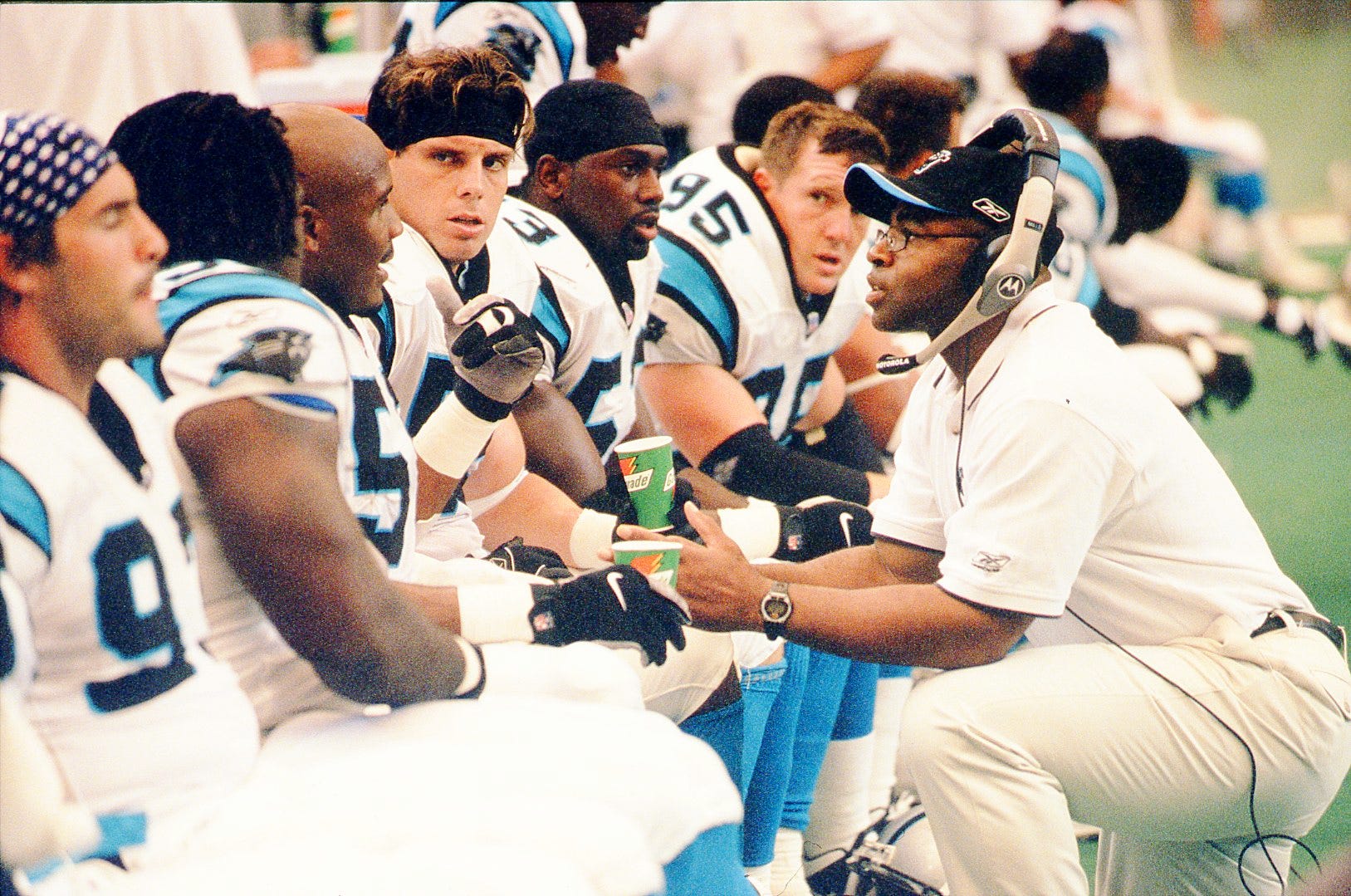
“No one blocks extra points; it just doesn’t happen,” Mills said. “But you guys believed you could and you did it.
“Just like you did that day, I’m going to keep pounding. They gave me three months. Three months and I was supposed to be dead. But I’m still here, and it’s because of you guys.”
Safety Mike Minter, who had played with Mills as a rookie in ’97 and spent 10 seasons with the Panthers, called it a “simple speech.”
“But that was Sam,” he says. “The great speeches aren’t great moments until later. Everybody who left the field that day knew.”
“Sam’s address became a big part of our success,” says John Fox. “It rallied the team. It rallied the whole city. I coached for more than 40 years and I never saw anything like it.”
Dan Morgan, a starting linebacker on that team and now the Panthers’ general manager, said he was fighting back tears by the end of Sam’s speech. He wasn’t alone.
There are some cynics who will tell you words can’t inspire a team to play better. But none of the people who would say that were there that day. Less than 24 hours after Mills addressed the team, the Panthers would go out and play their best game of the season, manhandling the Cowboys 29–10.
The game was never close. The Panthers scored on seven of their 12 possessions. Stephen Davis, who had been silenced by the Cowboys back in November, rushed for 104 yards in the win-or-go-home rematch, including a 23-yard touchdown run in the second quarter that gave the Panthers a 13–0 lead.
Delhomme also came up big, completing 18 of 29 passes for 273 yards, including a 32-yard touchdown pass to Steve Smith in the third quarter that put the game away. Smith also had a 70-yard catch that set up another score.
Keep Pounding became the team’s inspirational battle cry for the ’03 postseason. But it would become much, much more than that. It would become a legacy to one of the most beloved players in Panthers history.
Walk into the team’s locker room or weight room today more than two decades after that speech, and you will see Keep Pounding signs on the walls. A year after Sam’s death, Nike embroidered Keep Pounding inside the neck of the Panthers’ game jerseys. It’s been there ever since.
“What Sam said that day was a big part of our success,” says John Fox. “It rallied the team. It rallied the whole city.”
There is a giant Keep Pounding drum on the sideline at Panthers home games. Right before kickoff of every game, a special guest bangs the drum four times. Sam’s wife Melanie has done it. So have three of his children. There is a Keep Pounding cancer fund. There is an annual Keep Pounding 5K run in Charlotte. There is a Keep Pounding Blood Drive and a Keep Pounding Kids Program. Nearly $25 million has been raised under the Keep Pounding banner for cancer research.
The week after their wildcard win over the Cowboys, the Panthers defeated the St. Louis Rams in overtime, 29–23, on a 69-yard touchdown pass from Delhomme to Steve Smith.
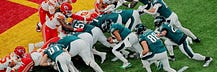
That set up a rematch with the NFC’s top seed, the Eagles, in the NFC Championship Game in Philly. The Panthers had lost to the Eagles at home in November, 25–16. But they went into Philly and beat the Birds 14–3 to earn their first-ever trip to the Super Bowl. Carolina’s defense had four interceptions and five sacks in the win. Dan Morgan had a team-high 13 tackles.
As Jim Skipper was leaving the field after the game, he saw Sam sitting alone on the visitor’s bench at Lincoln Financial Field. Two decades earlier, they both had started their pro careers in Philadelphia with the Stars, Skipper as an assistant coach on Jim Mora’s staff and Mills as a linebacker. They had become close friends. Their families were close.
“He had tears in his eyes,” Skipper says. “I didn’t bother him. He wanted to be alone. He needed time to reflect on whatever he was reflecting on. That touched me big-time. I’ll always remember that moment. It should’ve been one of the happiest times of my life. We were going to the Super Bowl. But I was a little subdued in the locker room thinking about Sam.”
The Super Bowl that year was in Houston. The Panthers’ opponent was Bill Belichick’s New England Patriots. The team flew down the Monday before the game, but Mills had a chemo treatment on Tuesday and was going to fly down separately later in the week.
The chemo treatment sapped Sam’s strength worse than usual. He had waited his whole life to get to the Super Bowl. And he could barely walk to the bathroom. He called his agent and friend, Brett Senior.
“I can’t believe it,” he told him in a soft, raspy voice. “This is something I always dreamed about. Getting to the Super Bowl. And I don’t have the energy to get up and walk right now.”
Senior said the two of them prayed together over the phone for a few minutes. Before hanging up, Mills said, “Brett, I’m going to be there.”
Somehow, someway, Mills made it to Houston. At 6 a.m. on the morning of the Super Bowl, Senior’s phone rang.
It was Mills.
“I’m going out for a run,” Mills told Senior. “I feel great.”
“You do? Really?” Senior said in disbelief. “That’s terrific.”
“Now, I don’t know if he actually felt great,” Senior says now. “But he did go out for a two-mile run.”
That night, Mills was on the sideline coaching against Tom Brady and the Patriots in Super Bowl XXXVIII. Trailing by seven in the fourth quarter, the Panthers drove 80 yards on seven plays to tie the game with 1:08 left on a 12-yard pass from Delhomme to Ricky Proehl. But John Kasay’s ensuing kickoff went out of bounds, giving Brady the ball on his own 40-yard line. He drove the Patriots close enough for Adam Vinatieri to win the game with a 41-yard field goal, 32–29.
To this day, the players and coaches on that Panthers team are convinced that Mills’ inspirational Keep Pounding address before the Dallas game was what propelled them to the Super Bowl.
“Did Sam’s speech give us a little more juice in that playoff run?” Ken Flajole says. “No doubt about it. You like to think that when you finally get into the tournament, you should have enough juice.
“But I think the guys had a little something extra. Because they weren’t only playing for themselves, and their families, and the organization. I think they felt they were playing for Sam.
“They wanted to win for Sam.’’
Phenomenal. I can't wait to read your book. I am familiar with Sam Mills and his career from growing up watching the USFL and those fantastic Saint teams. Thank you for taking us inside his journey and that 2003 playoff run even if it did come at the expense of me an Eagles fan. I worked the desk that night at the Delco Times and remembered the city being in mourning the next day because many thought it was the Eagles year especially after that comeback. Can't wait to read soon.